


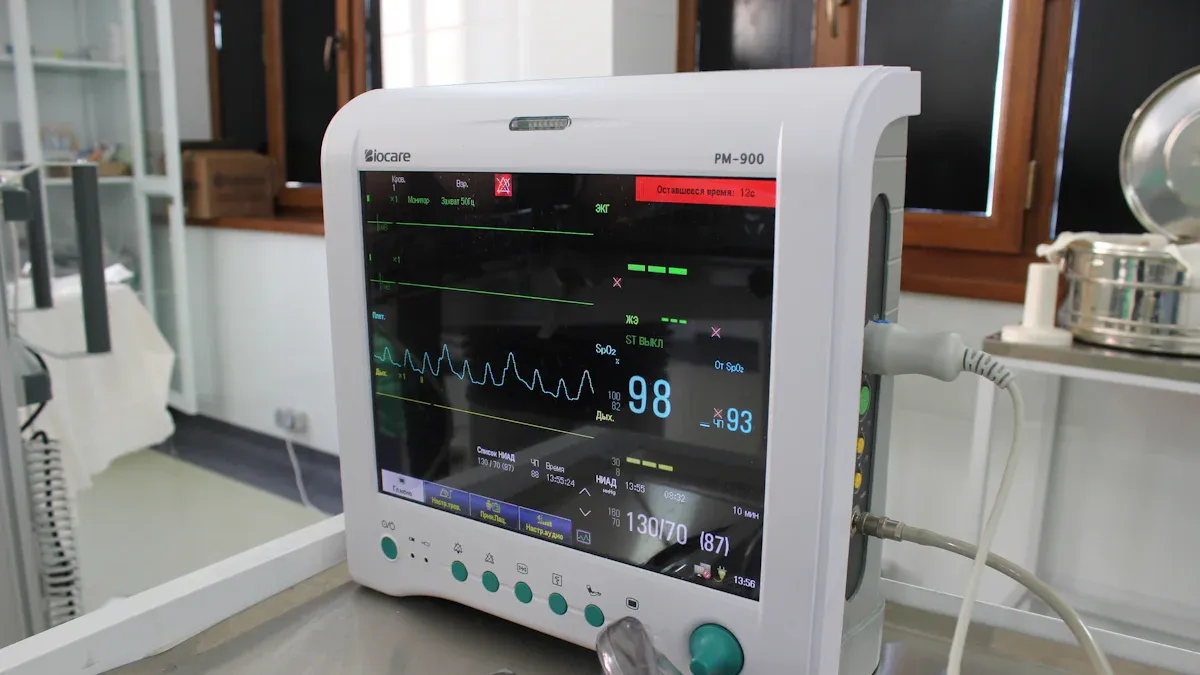
When you use medical equipment, you must understand how patient contact affects safety. B, BF, and CF classifications show you the difference in protection levels for each patient. The standard IEC 60601-1 helps keep your device safe by setting rules for leakage current and insulation. If you want to ensure patient protection, you need to look for 2×MOPP and low-leakage current power supply in your medical power adapter. Understanding the differences in patient contact types and safety protection levels (B, BF, CF types) helps you choose the right solution.
Key Takeaways
-
Learn about B, BF, and CF classifications to keep patients safe when using medical devices. – Always check for2×MOPP labelson medical power supplies for the best patient protection. – Make sure leakage current is low to stop electric shocks and keep medical equipment safe. – Look for IEC 60601-1 certification to know your medical power supply follows safety rules. – Pick medical devices with good insulation and low leakage current to make patients safer.
Patient Contact Types and Safety Levels in Medical Devices
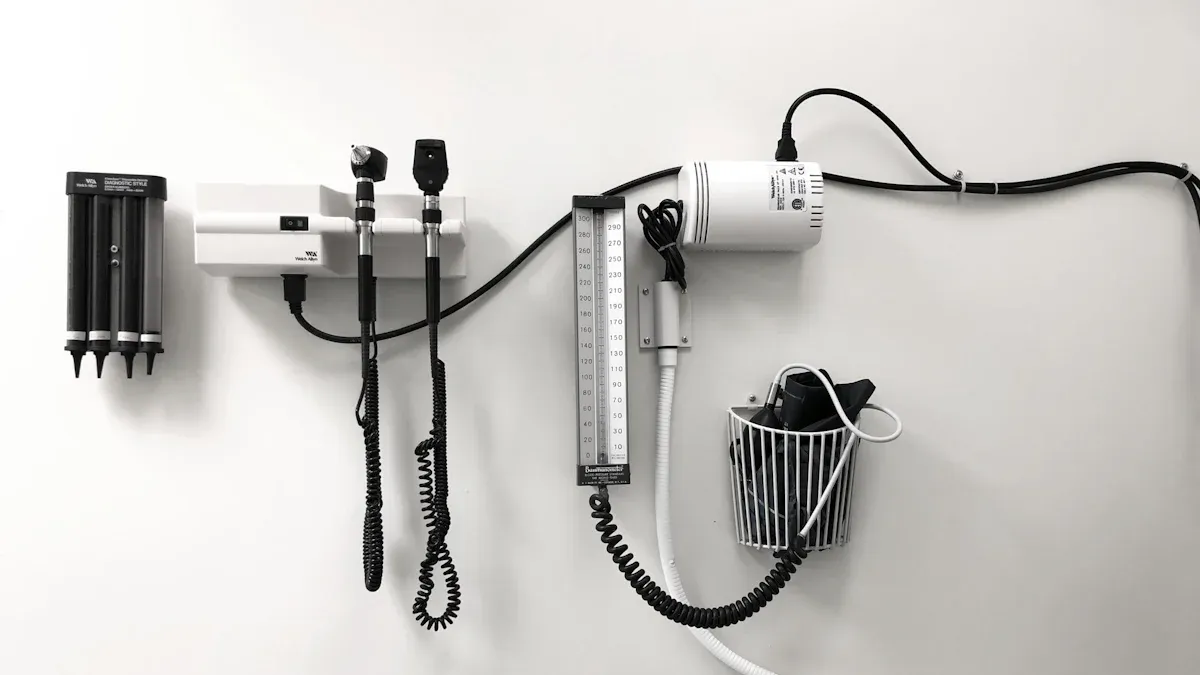
Understanding B, BF, and CF Classifications
When you look at medical electrical equipment, you need to Understanding the differences in patient contact types and safety protection levels (B, BF, CF types). The classification shows how the device touches the patient and how much it protects them. There are three main types: B, BF, and CF. Each type helps keep patients safe in a different way.
Here is a table to help you Understanding the differences between patient contact types and safety protection levels (b, bf, cf types) for various medical devices:
|
Classification |
Patient Contact Type |
Description |
Protection Requirements |
|---|---|---|---|
|
Type B |
Not conductive, may be connected to earth |
General applied parts not intended for direct patient contact. |
1 x MOPP |
|
Type BF |
Electrically connected to the patient, must be floating |
Applied parts that are not in direct contact with the heart. |
2 x MOPP |
|
Type CF |
Suitable for direct cardiac connection |
Applied parts that connect directly to the heart, including for procedures like dialysis. |
2 x MOPP |
You can see that type bf and type cf both need2×MOPPfor more safety. Type bf is for devices that touch the body but do not reach the heart. Type cf is for devices that go right to the heart.
Patient Safety and Device Application
You need to Understanding the differences in patient contact types and safety protection levels (B, BF, CF types) when picking a device for a medical job. Type B is for things with low risk, like hospital beds or lights for therapy. Type bf is for things like blood pressure cuffs or ultrasound tools that touch the skin. Type cf is for devices that connect to the heart, like defibrillators or dialysis machines.
Tip: Always check the classification before you use any medical electrical equipment. This helps you pick the right device for the right patient use.
Here is a quick listto help you remember:
-
Type B: Hospital beds, MRI scanners, phototherapy equipment
-
Type BF: Blood pressure monitors, incubators, ultrasound equipment
-
Type CF: Defibrillators, dialysis machines
IEC 60601-1 and Safety Standards
The IEC 60601-1 standard gives the rules for Understanding the differences in patient contact types and safety protection levels (B, BF, CF types). It tells you how much leakage current is okay for each type. Type bf and type cf devices must follow strict rules to keep patients safe. The standard also says type bf and type cf need 2×MOPP, which means double insulation for extra safety.
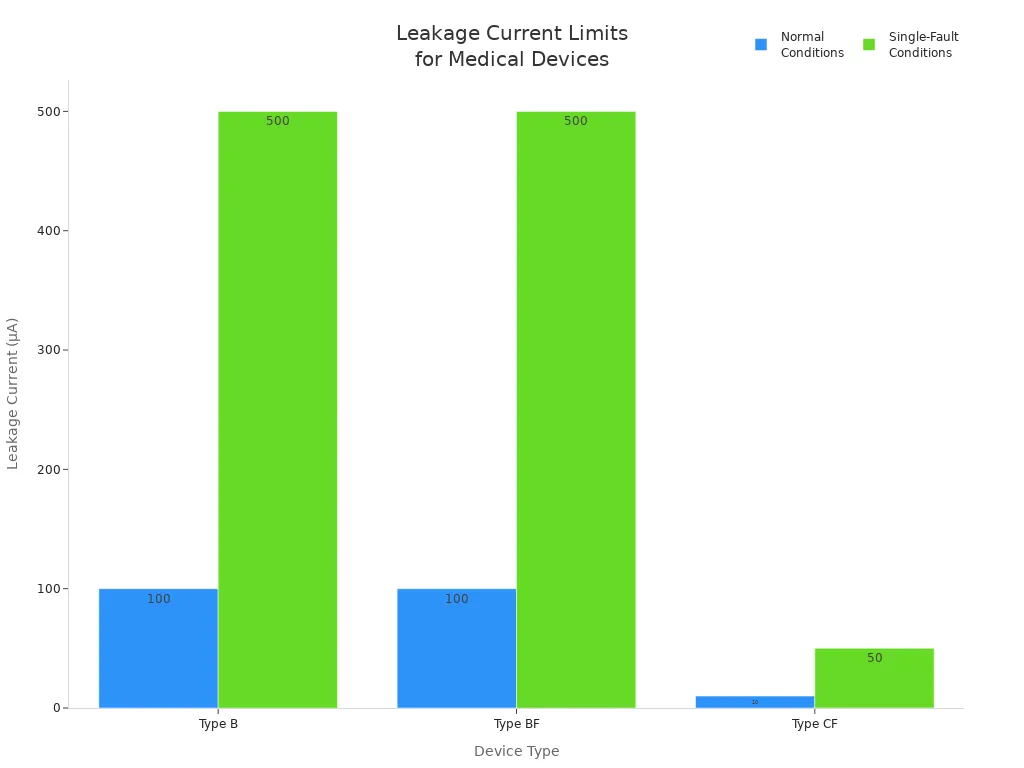
Here is a chart that shows the most leakage current allowed for each type:
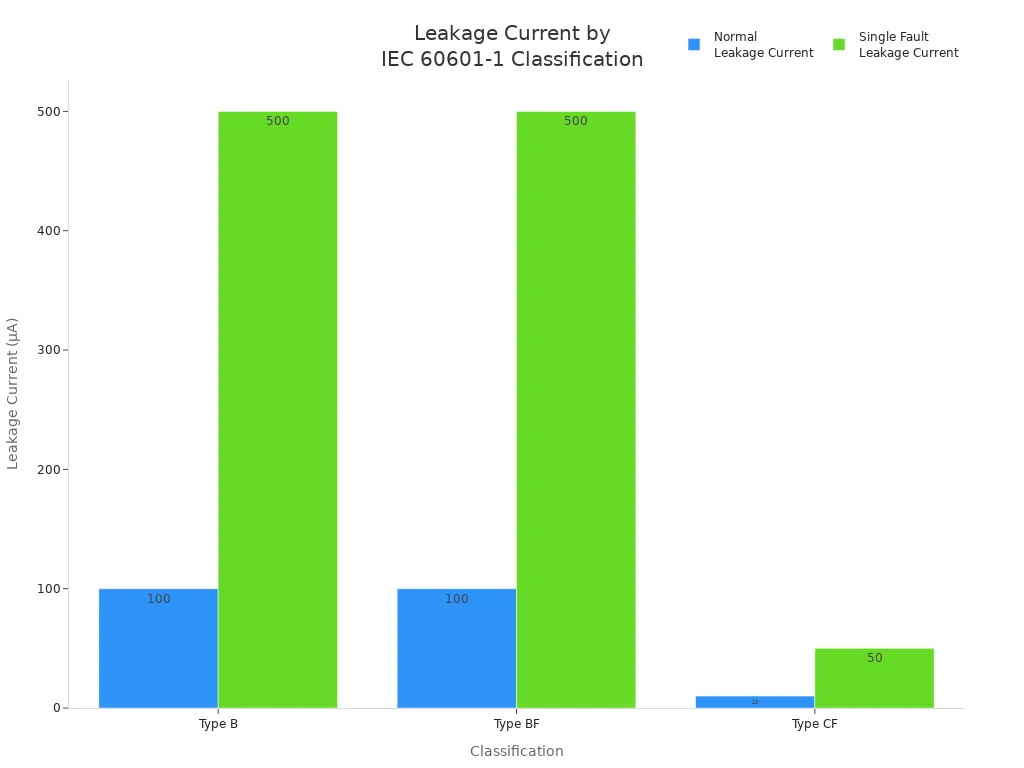
You can see that type cf has the lowest leakage current limits. This is because devices that touch the heart need the most patient protection. When you pick a medical power adapter, always look for leakage current and make sure it meets IEC60601-1 for your device’s type.
Leakage Current and Patient Protection
What Is Leakage Current in Medical Devices?
When you use medical equipment, you should know about leakage current. Leakage current is extra electricity that is not needed. It moves from a circuit to the earth or the case. This can happen because of things like parasitic capacitance or bad insulation. Sometimes, it comes from EMC filter circuits too. The IEC 60601-1 standard sets rules to keep leakage current safe for patients.
The main places where leakage current comes from in medical power supplies are:
-
Capacitive coupling between metal parts
-
Inductive coupling from transformers
-
Parasitic capacitances on circuit boards
-
Insulation problems from old age or damage
Risks to Patient Safety
You have to keep leakage current low to keep patients safe. If leakage current gets too high, itcan cause tiny shocks. These shocks can mess up the heart’s rhythm. It can also burn or hurt the skin if the current escapes. Sensitive electronics in the device might stop working right. Hospitals can get in trouble if they do not check for leakage current.
Note: Keeping leakage current low is very important for patient safety in all medical equipment.
Leakage Current Limits for B, BF, and CF
The IEC 60601-1 standard gives strict rules for leakage current based on device type. Type B and BF devices can have up to 100µA in normal use. They can have up to 500µA if something goes wrong. CF devices, which touch the heart, have much lower limits. They can only have 10µA in normal use and 50µA if there is a problem.
|
Device Type |
Normal Conditions |
Single-Fault Conditions |
|---|---|---|
|
Type B |
100µA |
500µA |
|
Type BF |
100µA |
500µA |
|
Type CF |
10µA |
50µA |
You should always make sure your medical device and its power supply follow these leakage current rules. Using a low-leakage current power supply and following 2×MOPP rules gives the best protection for patients. This is very important for BF-type and CF-type devices. Always look forIEC60601-1 certificationwhen picking a medical power adapter for your equipment.
2×MOPP and Medical Power Supply Safety
What Is 2×MOPP?
It is important to know what2×MOPPmeans for medical power supplies. This stands for “two Means of Patient Protection.” It is a big part of the IEC60601-1 standard. Devices with 2×MOPP give the highest safety for patients. BF and CF type medical equipment use this protection.
-
2×MOPP hastwo layers of insulationto stop electric shock.
-
If one layer breaks, the other layer still keeps patients safe.
-
These designs use double insulation and longer creepage distances.
-
The isolation rules need 4000Vac isolation voltage and 8mm creepage distance.
-
This setup helps stop leakage current from reaching the patient.
You should always look for 2×MOPP when picking a medical power supply. This label means the device follows strict safety rules.
Insulation, Creepage, and Clearance Requirements
You need to know the technical rules for 2×MOPP. The IEC60601-1 standard gives clear rules for insulation, creepage, and clearance. These rules help keep patients safe in hospitals.
The MPU01 series shows how makers follow these rules. It can handle high isolation voltage up to 5kVac. It uses an 8mm creepage distance. This design meets the 2×MOPP rules for strong insulation.
|
Feature |
Requirement |
|---|---|
|
Insulation Requirements |
High (e.g., 4000VAC for 2×MOPP) |
|
Creepage/Clearance |
Increased distances for safety |
The output of a medical power supply must be separated from the mains by 2×MOPP. Patient connections must also be kept away from the mains by 2×MOPP. This keeps leakage current below safe levels and away from the patient. You should never connect a secondary circuit straight to the patient connection of a BF or CF part.
Makers have problems when they try to follow these rules. They must keep electrical isolation strong. They need to control leakage currents. They must make sure design changes do not break the rules.
|
Challenge |
Description |
|---|---|
|
Electrical Isolation |
Devices must keep strong isolation to protect patients from electric shock. |
|
Leakage Currents |
You must manage earth and enclosure leakage currents to meet safety rules. |
|
Design Changes |
Any change in design can affect compliance with MOPP requirements. |
MOPP vs MOOP in Medical Devices
It is important to know the difference between MOPP and MOOP when picking medical equipment. MOPP means “Means of Patient Protection.” MOOP means “Means of Operator Protection.” MOPP rules are stricter because patients need more protection than operators.
-
The creepage distance for 1 MOPP is harder to meet than for 1 MOOP.
-
You need 8mm creepage distance for 2×MOPP, which is double that of 1×MOPP.
-
MOPP rules need higher isolation, like 4000Vac, compared to MOOP.
-
MOPP rules protect patients by using tougher requirements.
-
MOOP rules are less tough because operators have lower risks.
-
Devices that meet MOPP rules also protect operators, giving more safety.
MOPP rules are made to keep patients safe in hospitals. You should always pick devices that meet MOPP rules, especially for BF and CF type medical devices. This keeps both patients and operators safe when using the equipment.
Ensuring Compliance in Medical Power Supplies
Design for Low Leakage and Isolation
You need to use smart design ideas to meet safety rules. Medical tools like ultrasound machines and patient monitors need low leakage and strong isolation. This keeps patients safe. ECG devices also need these features. The table below shows some ways to help you reach these goals:
|
Design Strategy |
Description |
|---|---|
|
High-Quality Insulation |
Reinforced or double insulation lowers leakage currents and improves patient protection. |
|
Isolation Techniques |
Galvanic isolation blocks leakage currents from reaching patient-contact areas. |
|
Component Selection |
Low-leakage components help your device meet regulatory requirements. |
|
Proper Grounding |
Directs leakage current away from the patient and operator. |
|
Compliance Testing |
Rigorous tests confirm leakage current stays within safe limits. |
Double insulation uses two layers to keep patients safe from power circuits. This helps stop electric shock. Good grounding also lowers the risk of burns or organ damage. You must check that input-to-output, input-to-ground, and output-to-ground isolation all meet safety rules.
Testing and Certification for Safety
You must test your equipment to make sure it is safe. Tests check isolation and leakage current. You need to test both normal use and when something goes wrong. Here are the main steps:
-
Measure leakage current when the device is on standby and working.
-
Test what happens if the ground or neutral wire opens.
-
Put the device on an insulating surface, 20cm from metal.
-
Measure earth leakage, touch leakage, patient leakage, and patient auxiliary leakage.
-
Run the device at 110% of its highest rated voltage and frequency.
Certification marks prove your device meets safety rules. Look for these marks on your medical power supply:
|
Certification Mark |
Description |
|---|---|
|
CE |
Conforms to EU directives. |
|
UKCA |
Meets UK regulations. |
|
IEC 60601 |
Follows international medical equipment standard. |
|
UL |
Meets North American safety standards. |
|
KC Mark |
Follows South Korean standards. |
Selecting Safe Medical Power Supplies
When selecting a medical power supply for BF-type or CF-type medical devices, several critical factors must be considered:
-
Make sure the output voltage and current fit your device.
-
Pick a power rating with extra room for your equipment.
-
Choose a shape and size that works for your use.
-
Check the input and output connections for your setup.
-
Make sure the device stays cool with good thermal management.
-
Use sealed supplies for tough places.
-
Check that it meets IEC60601-1 and other safety rules.
-
Know if your device touches the patient or stays close.
-
Look at other standards like IEC60601-1-2 for electromagnetic safety.
-
Use dual line fusing for more protection.
Tip: Always pick a medical power adapter with 2×MOPP, low leakage current, and clear safety marks. This helps you follow the rules and gives the best patient protection.
You should know what each classification means to keep patients safe.BF-type and CF-type devicesgive more patient protection. The performance and safety improve further when a low-leakage current power supply is used. Always make sure the device followsIEC60601-1 and 2×MOPP rules.
-
Pick medical power supplies that follow tough safety rules.
-
Find ones with extra insulation and low leakage current.
-
Check the product info to see if it works well and is reliable.
|
Aspect |
Description |
|---|---|
|
Standards |
IEC 60601-1 and 2×MOPP rules help stop electric shock and keep strong isolation. |
|
Patient Protection (MOPP) |
Special designs keep patients safe from electric shock in hospitals. |
|
Operator Protection (MOOP) |
Different rules help keep medical workers safe too. |
Dilithink medical power adapter follow IEC60601-1 and 2×MOPP rules. This makes them good for medical equipment that needs high safety. Visit Dilithink’s website athttps://medicaladaptertech.com/to learn more about safe medical power supplies.
FAQ
What does 2×MOPP mean in medical power supplies?
2×MOPPstands for “two Means of Patient Protection.” You get double insulation and higher isolation voltage. This helps you meet IEC60601-1 standards and provides better patient protection, especially for BF-type and CF-type devices.
Why is low leakage current important for medical devices?
Low leakage current helps keep patients safe from electric shock. You need a low-leakage current power supply to comply with IEC60601-1 requirements. This is especially important for medical devices that come into contact with the body or heart, such as BF-type and CF-type equipment.
How do I know if a medical power adapter is safe for CF-type devices?
Always check for IEC60601-1 certification, 2×MOPP labeling, and low leakage current ratings. These features indicate that the medical power adapter provides strong patient protection for CF-type applications.
What is the difference between BF-type and CF-type classifications?
|
BF-type |
CF-type |
|---|---|
|
Body contact |
Cardiac contact |
|
Higher leakage current allowed |
Lowest leakage current required |
|
Needs 2×MOPP |
Needs 2×MOPP |
You use CF-type for direct heart contact. BF-type is for other body contact.
For reference, please see the following authoritative sources on medical device safety standards:
About Dilithink: Dilithink specializes in certified medical power adapters designed for BF-type and CF-type applications.
All products meet IEC60601-1 and 2×MOPP standards, offering low-leakage current performance and reliable patient protection for high-safety medical devices.
Author: Nikki
Senior Product Manager at
DILITHINK Electronics Co., Ltd.
With over 15 years of experience in medical power supply design, Nikki specializes in IEC60601-1 compliance,
low-leakage current solutions, and 2×MOPP insulation innovation to ensure patient safety and reliability.


